
Connecticut · Fairfield County
Home care in Easton
Easton runs the most generous municipal senior transport we have found anywhere in three states. Knowing that changes what you should be buying from us, and how little of it.
Does Endurance Home Care provide home care in Easton?
Yes. We provide home care throughout Easton, Connecticut, from our Connecticut office at 60 Long Ridge Road in Stamford. Care includes hourly support, live-in care, awake overnight cover, personal care, companionship and memory support at home.
In numbers
What the census says about who lives in Easton
Four figures that change how care actually runs in a town, and the release they came from.
- Residents
- 7,670
- Aged 65 and over
- 1,278 (16.7%)
- Median year homes were built
- 1974
- Median home value
- $783,100
In Easton, 16.7% of residents are 65 or over. Across the 91 towns Endurance serves, that share runs from 10.2% to 32.9%, with a median of 18.3%. Easton sits below that middle.
Every figure on this scale comes from the same census release read for the same kind of geography, so the towns are comparable with each other. It is not a state or national ranking.
ACS 2024 5-year, tables B01001, B25035 and B25077, geography 06000US0912023890 (Easton town, Greater Bridgeport Planning Region, CT). Connecticut replaced county geography with planning regions for census purposes in 2022, so the region named above is the one the figures were read from.
The most permissive municipal transport we have found, and it is not close
Easton's Council on Aging runs two buses. They are free. They are open from age 55, where every other town in this corner of the county starts at 60. They are door to door with a wheelchair ramp and lift. And the town describes them as available 24 hours a day, seven days a week.
The destinations are the part that matters most. Not just the shops and the senior centre, which is where most municipal vans stop, but hospital visits to Norwalk, Bridgeport, St. Vincent's, Danbury, Yale and the West Haven VA. Doctor appointments. Physical therapy, chemotherapy and dialysis, named explicitly. Pharmacy and prescription pickups. The drivers will collect or deliver loaned medical equipment, and will do the grocery shop outright for a resident who cannot leave the house.
That is a description of the exact journeys that follow a hospital discharge, provided free by a town of under eight thousand people. It is worth saying plainly because it is unusual, and because we would rather a family used it than paid us to duplicate it.
Two towns north, Sherman's van carries no medical trips at all. Monroe, on the other side, wants five days' notice and prior membership of its senior centre. Same county, same kind of service, entirely different answer.
What the bus cannot do, which is where we come in
The gap in Easton is narrow and specific, and it is worth identifying precisely rather than selling around it.
A surgery drop-off still needs a responsible adult for the return journey. That is a hospital's rule rather than the town's, and no transport service solves it. Somebody has to be there, and the bus is not somebody.
The service also publishes no advance-notice rule, which is a genuine convenience and a genuine uncertainty. Nothing stops you asking at short notice, and nothing promises the answer will be yes. For a scheduled course of dialysis or physical therapy that is fine. For the unplanned afternoon it is a question mark, and question marks are expensive when somebody is unsteady.
And a bus covers the journey rather than the day. The hours a household in Easton actually struggles with are the ones at either end of the trip: getting somebody up, washed, dressed and ready, and then settled again afterwards when they are more tired than they expected to be. That is a short arrangement, not a package.
Seven and a half thousand people on land
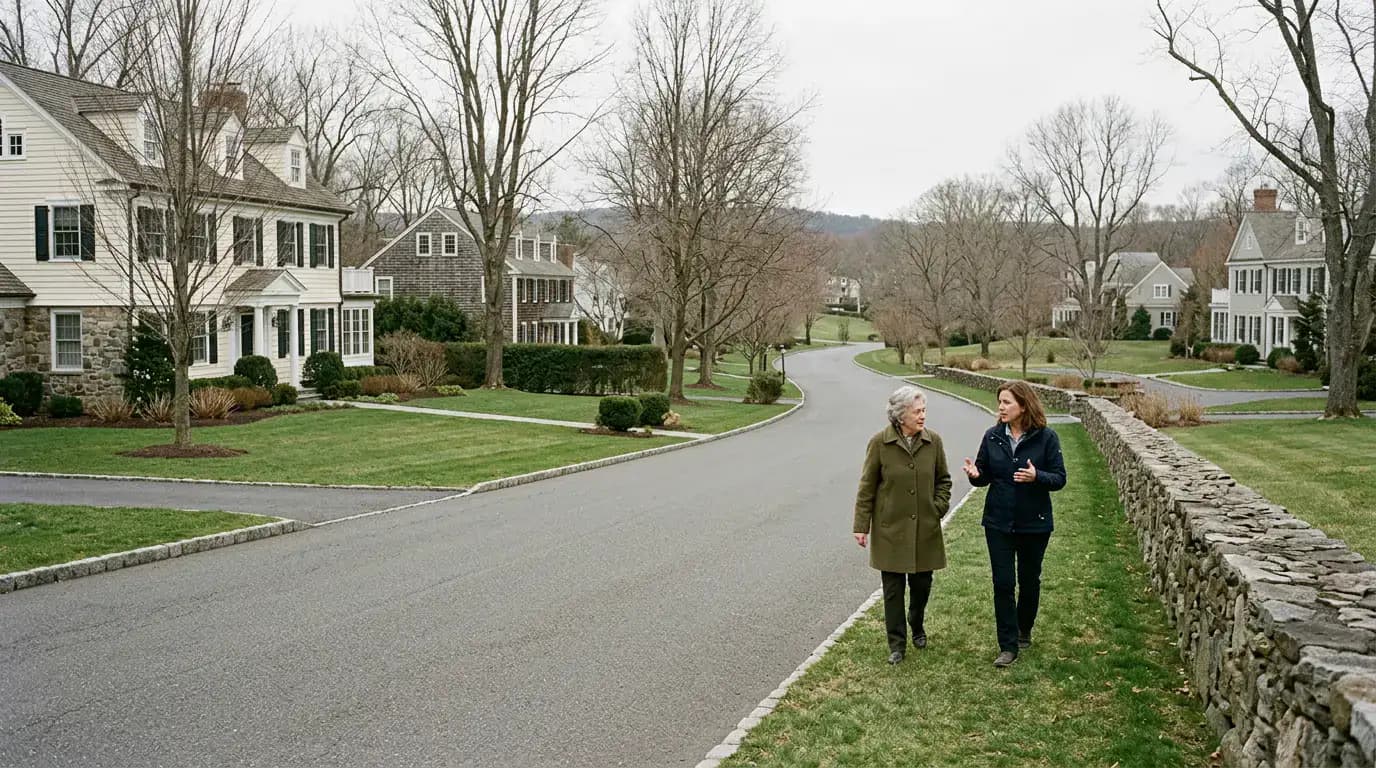
Easton has about 7,670 residents and 16.7 per cent of them are over 65, which is unremarkable for this county. The median home dates to 1974, late enough that stairs are usually navigable and a ground-floor bathroom is often either present or possible.
What is not unremarkable is the density, or rather the absence of it. Easton is a town of large lots, long private drives and unlit roads, with no walkable centre in the sense that Westport or New Canaan have one. The care problem here has almost nothing to do with the building and almost everything to do with the distance between buildings.
That shapes shift length more than anything clinical does. A one-hour visit with a thirty-minute drive at each end is not a service worth anybody paying for, so cover here is arranged in longer blocks and fewer of them. Live-in care often works out better than hourly for reasons that are geographic.
It also means winter matters operationally. A caregiver who cannot drive cannot work this town, and a plan that assumes somebody can be there quickly has not looked at where the roads go.
What we do and where it stops
Everything we provide is daily-living. Personal care, bathing, dressing, mobility support and transfers within a caregiver's training, medication reminders, meal preparation, the household routine, companionship, and being the responsible adult on the return leg when a hospital requires one.
Nothing about the line beyond that is soft. No skilled nursing, no wound care, no injections, no therapy, no medication administration or dose adjustment, and no clinical assessment. Where a clinical plan already exists we work under it rather than directing it.
In a town this well served the honest answer is frequently that a household needs less than it came expecting to buy. Use the buses hard. They are free, they go where the appointments are, and they will collect your mother's walking frame. Then buy the specific hours the buses cannot reach, which are usually the morning either side of a treatment day.
That is a smaller sale than a blanket package and it is the right starting point here. If it turns out not to be enough, adding hours is easy. Unwinding a package nobody needed is a conversation neither of us enjoys.
Public provision
What Easton already provides, and where it stops
Worth knowing before you pay for anything. Where these cover the gap, use them.
Easton Senior Citizens Center
650 Morehouse Road, Easton, CT 06612
Open Monday to Friday, 8am to 3.30pm.
Easton Senior Center bus service, run by the Council on Aging
Two town buses described as available 24/7 for Easton residents aged 55 and over and residents with disabilities, accompanied by an adult or aide where needed. Door to door and dial a ride, with wheelchair ramp and lift. Named destinations include hospital visits to Norwalk, Bridgeport, St. Vincent's, Danbury, Yale and the West Haven VA, doctor appointments, physical therapy, chemotherapy and dialysis, pharmacy pickups, groceries, bank, post office and religious services.
No advance-notice window is published, which cuts both ways: nothing stops a short-notice request, and nothing guarantees one either. A surgery drop-off still needs a responsible adult for the return leg, which the bus cannot supply.
St. Vincent's Medical Center
2800 Main Street, Bridgeport, CT 06606
We are not affiliated with any of these and we do not speak for them. They are listed because a family working out what Easton already offers should not have to find them one at a time.


The honest part
When home in Easton is the wrong answer
When home may not be the right setting
- Ongoing skilled nursing needs. We are a home care agency and cannot meet them, whatever the hours.
- A house that cannot be made navigable for the physical support required, where the modification would cost more than it solves.
- A situation needing a clinical response in minutes rather than someone to observe and call.
- Isolation that hours cannot fix, where a residential community would give someone more of a life rather than less.
If any of these describes your situation, say so on the call. A responsible advisor should tell you when a different setting fits better, and ours are asked to.
Questions about home care in Easton
Do the Easton buses really run 24 hours?
That is how the town describes them: two buses available 24/7 for residents aged 55 and over and residents with disabilities, free, door to door, with a wheelchair ramp and lift. No advance-notice rule is published, which means nothing stops a short-notice request and nothing guarantees one either.
Will they take somebody to chemotherapy or dialysis?
Yes. The town's transportation flyer names physical therapy, chemotherapy and dialysis explicitly, alongside hospital runs to Norwalk, Bridgeport, St. Vincent's, Danbury, Yale and the West Haven VA. Drivers will also collect or deliver loaned medical equipment.
So what would we actually need from you?
Usually the hours either side of the journey rather than the journey. Getting somebody up, washed and ready before a treatment appointment, and settled afterwards when they are more tired than they expected. Plus the return leg after a procedure, where the hospital requires a responsible adult and a bus cannot be one.
Why is care in Easton arranged in longer shifts?
Distance. A one-hour visit with a thirty-minute drive at each end is not worth buying. Cover here works better in longer blocks and fewer of them, and live-in care frequently suits this town better than hourly. That is geography rather than acuity.
Do you provide nursing?
No. Daily-Living support only: no nursing, no therapy, no medication administration, no clinical assessment. Where a clinical plan exists we work alongside it and we do not direct it.
Nearby: Weston, Monroe, Trumbull. Or the Fairfield County hub.
Our client line is (203) 936-6847. It is not an emergency line.