

How to Talk to Someone With Dementia
Stop correcting them and listen for the feeling under the sentence, because that part is still exact.

When communicating with a person living with dementia, the Alzheimer's Association advises avoiding criticism and correction, and listening instead for the meaning in what the person says.
The reflex that makes it hard looks exactly like kindness.
Someone says a thing that is not so, and the person who loves them puts it right. The Alzheimer's Association guidance for daily care goes the other way. Avoid criticizing or correcting, it says. Listen, and try to find the meaning in what the person says.
Meaning is the word doing the work there. A question about a mother who died thirty years ago is rarely a question about a fact. It is usually a request for reassurance, or a worry with nowhere to put itself down, or a need that has not found its own name yet. Answer the fact and the need is still standing in the room. Answer the need and the exchange tends to settle on its own.
Dropping the correction habit is the highest yield change most families can make, because it costs nothing, it works in every room of the house, and it needs no training to begin. It is also the hardest, because correcting feels like helping while you are doing it.
Care professionals here are trained on disease states and on health and wellness, which is why the first thing families tend to notice is what a caregiver does not do. No argument about the day of the week. No quiz about who just left the house.
When the sentence is not true, read it as a question about what
It is a worry about a person
Answer the worry, not the calendar. Say the person is safe, then move the conversation somewhere it can rest.
dementia care at homeThe hard exchanges cluster late in the day
When the same conversation goes wrong at the same hour every afternoon, the hour is worth looking at before the words are.
what to do when sundowning startsIt is an empty afternoon looking for a subject
A repeated question is sometimes just the only thing left to do. Something to do with the hands changes the question.
activities for dementia patients at home

Ask questions that one word can answer
Yes or no.In the middle stage of Alzheimer's, the Alzheimer's Association advises asking yes or no questions, such as would you like some coffee, rather than open ended ones. The reason is mechanical rather than mysterious. An open question asks a person to search for a word, hold the question in mind while the search runs, and then assemble an answer out of what comes back. A yes or no question asks for one of two things already sitting on the table.
Stage guidance written for Alzheimer's applies to most households reading this, because Alzheimer's disease is the most common cause of dementia and accounts for 60 to 80 percent of cases. Source: Alzheimer's Association, the difference between dementia and Alzheimer's.
What follows is the same rule written out four times, the way a phrase gets written under a staff so it can be read back later.
Would you like some coffee?
One word answers it. The alternative, what would you like to drink, asks for a search.
Tea, or coffee?
Two visible options work the same way. Hold both up where they can be seen if you can.
Are you cold?
Answerable. How are you feeling is an essay question wearing a friendly face.
Shall we sit by the window?
An invitation with a yes already inside it, and somewhere to go afterward.
None of this is a script, and a person who is being handled can tell. The point of the shape is only that it removes work from the other side of the conversation, so that whatever they still want to say has room left to arrive.
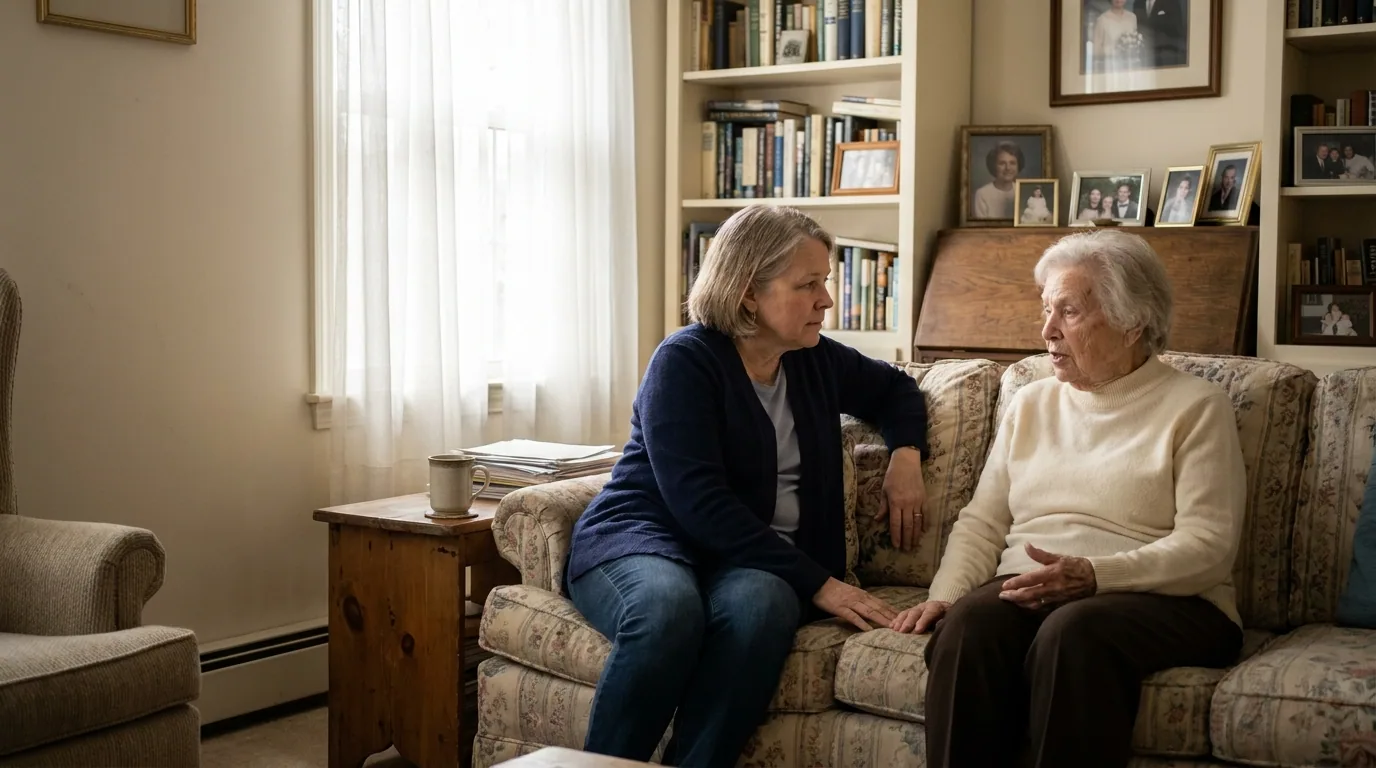
Later on, the feeling carries more than the vocabulary
Families often arrive at this page with a middle stage problem and leave with a late stage one, because the ground moves. For a long stretch, words still carry the exchange and the yes or no shape is most of what is needed. Then the words thin out, and the same question asked the same careful way stops landing.
The guidance for that stretch is different in kind, not in degree. In late stage communication the emotions being expressed can matter more than the words, so caregivers are advised to consider the feelings behind words or sounds. A sentence that does not parse can still be perfectly clear about whether the person is frightened, or comfortable, or done with the room.
In practice that turns the job from listening for content into listening for tone. Answer what you hear underneath. Tone, unhurried presence, and touch where it is welcome do most of the work at that point, and a long silence beside somebody stops being an awkward one.
It is worth saying plainly what this is and is not. This is guidance about how to speak, from the organization that publishes it. It is not treatment, it does not act on the disease, and nobody should choose it instead of talking to a doctor. Alzheimer's Association, communication and daily care.
Respond to the feeling, not to the vocabulary.
- Middle stage
- Yes or no questions. Two visible options. One word gets you an answer.
- Late stage
- The feeling behind the words or sounds. Tone, presence, and time.
- Both stages
- No correcting. Listen for the meaning in what the person says.
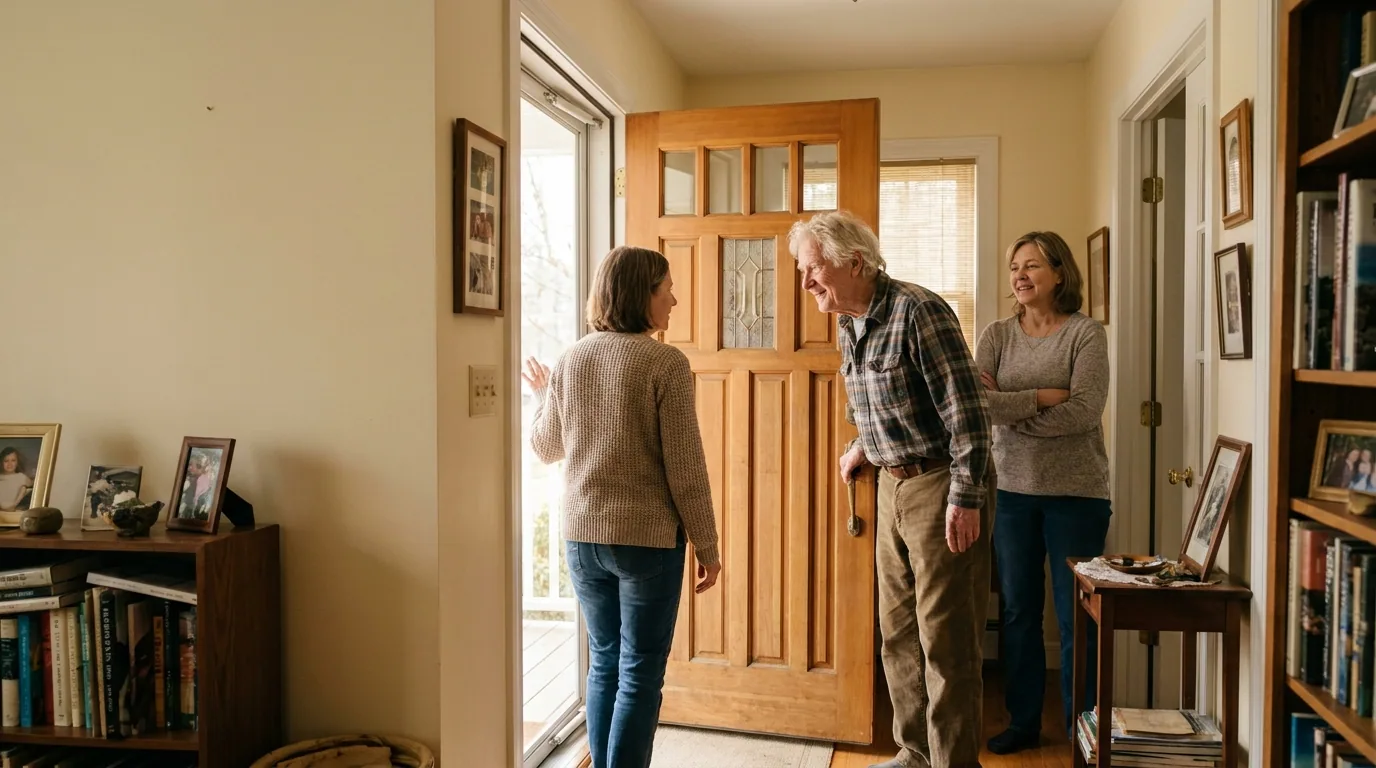
What this sounds like across a shift
A caregiver lets themselves in and does not open with a test. Not do you remember me. Would you like some coffee, and the coffee is already the answer to the question. Through the morning the questions stay answerable, and the ones that are not true are not argued with. A worry about a person gets the worry answered. A story that has moved thirty years gets listened to for what it wants, which is usually reassurance.
By late afternoon the shape changes again, and so does the caregiver. Fewer questions. Shorter sentences. More attention on the feeling behind the sounds than on the sounds. The training behind that covers disease states and health and wellness, and it is the reason the same hour can go two very different ways depending on who is in the house.
It is daily-living work throughout. Caregivers support, remind, accompany, coordinate, and supervise. If what your household needs is that presence on a regular schedule, that is in home dementia care.
Endurance Home Care provides care at home in Connecticut and New Jersey, with companion care only in New York. Skilled nursing, home health aides and physical therapy in Connecticut are provided by Endurance Home Health.
Questions families ask
how to talk to someone with dementia
Stop correcting. The Alzheimer's Association advises avoiding criticism and correction, and instead listening to find the meaning in what the person says. In the middle stage, ask yes or no questions such as would you like some coffee rather than open-ended ones. In late stages the emotions being expressed can matter more than the words, so respond to the feeling behind the sounds.
What if they say something that is not true?
Correcting rarely helps and often escalates the moment. The guidance is to avoid criticizing or correcting, and to listen for the meaning underneath: a request for reassurance, a worry about someone, a need that has not been named yet. Answering that need usually settles the exchange faster than establishing the facts.
How should questions be phrased?
In the middle stage of Alzheimer's, ask yes or no questions, such as would you like some coffee, rather than open-ended ones that require assembling an answer. Offering a choice between two visible options works on the same principle.
What changes in the late stage?
The emotions being expressed can become more important than the words, so caregivers are advised to consider the feelings behind words or sounds. Tone, touch where welcome, and unhurried presence carry more than vocabulary at that point.
The sentence was wrong. The feeling underneath it was not.
daily-living companion and home care across Fairfield and New Haven counties, Connecticut, from an agency licensed by the state.