
Guidance · Making the decision
Let care adapt to the person, not the other way around.
We provide home care in Connecticut and New Jersey; New York service is companion care only. Read this knowing our perspective, and that the facility column is written as a good facility would write it.
Should we choose home care or a facility?
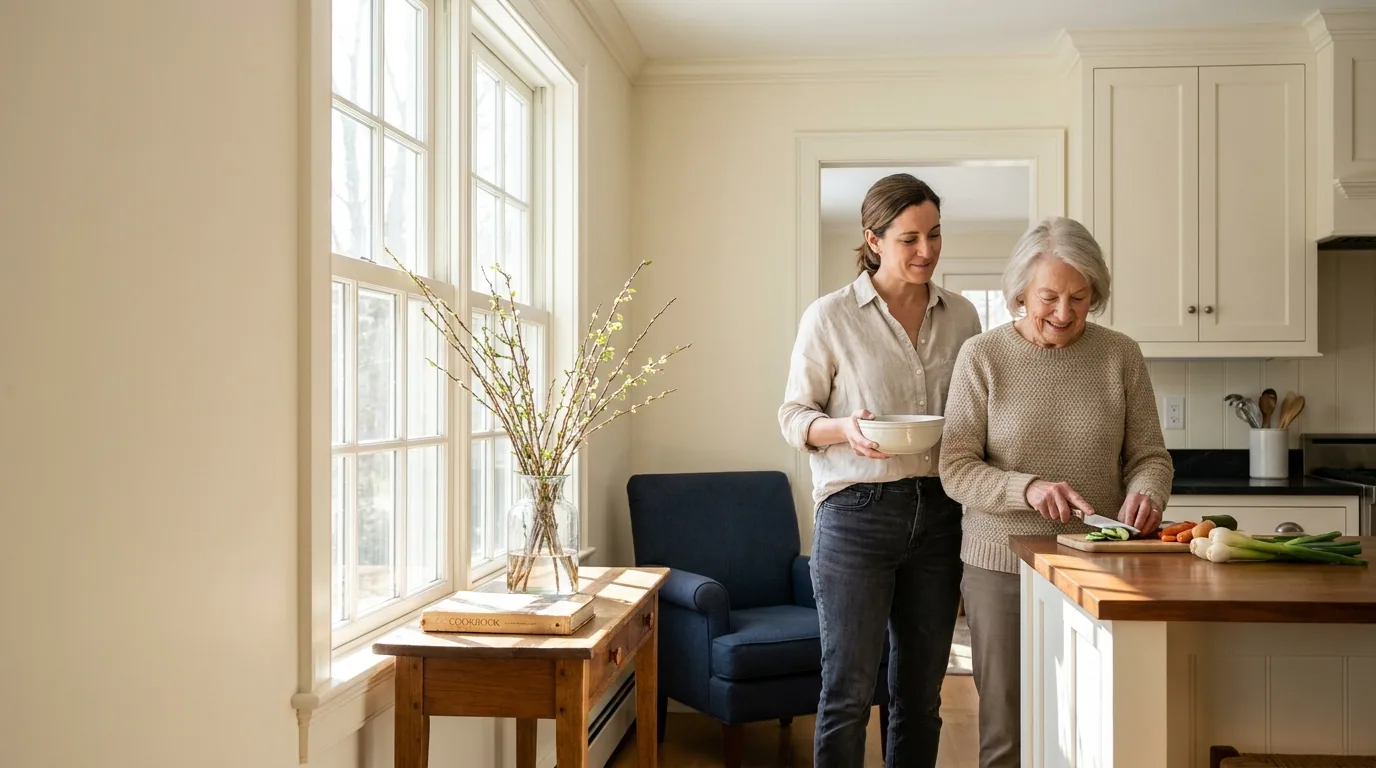
When a person's needs can be supported safely at home and staying home is what they want, home deserves to be the first option considered: the routines, relationships, and sense of control they are trying to protect are already there. When continuous clinical support, environmental safety, or company beyond what visits can provide is what is missing, a residential setting may genuinely offer more life rather than less.
Side by side
Seven dimensions, both columns written fairly
Including the cost row, which is the one home-care marketing usually leaves vague.
| What you are comparing | Care at home | A residential or care community |
|---|---|---|
| Environment and routine | The person stays in their own surroundings, with their own things, their own bed, and a routine that already exists rather than one they have to learn. | A shared setting with its own rhythm. Some people settle quickly and thrive; others never stop experiencing it as a loss, and it is hard to predict which in advance. |
| One-to-one attention | One caregiver, one person, for the hours booked. Outside those hours there is nobody, which is the part that has to be planned for honestly. | Staff attention is shared. In exchange, somebody is present at every hour rather than only the booked ones. |
| Who sets the schedule | The household. Meals, waking, bathing, and outings happen when they have always happened. | Largely the community, shaped by staffing. Meal times and bathing routines usually move to fit it. |
| The family's role | Closely involved by default, and able to stay in a family role rather than a nursing one once support is in place. | Participation within the community's structure, and often a real shift from care tasks back to relationship, which for exhausted spouses can be transformative. |
| Clinical intensity available | Daily-Living support only. Anything clinical arrives as a separate provider on a separate schedule, which works well and does need coordinating. | Varies by setting, and can be considerable. Assisted living, memory care, and skilled nursing are different levels and worth separating when you compare. |
| Social contact | Has to be deliberately planned: outings, visitors, activity, community. It does not arrive on its own, and isolation is the real risk of ageing at home. | Built in. Programming, dining, and neighbours are there without anyone having to arrange them, and for an isolated person that alone can change the whole picture. |
| What drives the cost | Hours, care model, market, and acuity. Part-time support is usually the least expensive option available. Round-the-clock awake care at home is frequently the most expensive option on this page. | Setting, room, acuity, services, and payer eligibility. Predictable monthly pricing, which for many families is easier to plan around than variable hours. |
| Best fit when | When needs can be met safely at home, staying home is what the person wants, and the household can be made to work for the level of support required. | When continuous clinical or environmental support exceeds what a safe home plan can provide, or when built-in company and structure would give someone materially more of a life. |
| Not the right choice when | When continuous clinical support is needed, when the home cannot be made safe for the mobility support required, or when the isolation is the problem rather than the tasks. | When the person's identity is bound up in their home and routine, when needs are manageable with support, or when the move would cost more than it solves. |
A general comparison of settings, not a comparison of specific providers. Facility capabilities differ enormously between assisted living, memory care, and skilled nursing, and those three are worth separating before you compare anything.
The case for home, made properly
What actually becomes possible when care is built around one person
Not a critique of facilities. A description of what the alternative is protecting.
- Familiar surroundings and an existing routine, which for someone with memory changes is not sentiment but a genuine functional support.
- Schedule control: waking, meals, bathing, and outings at the times they have always happened.
- One-to-one attention during booked hours, rather than attention shared across a floor.
- The family stays in a family role, which is often what the exhausted spouse or daughter is really buying.
- Relationship continuity with a small number of caregivers who learn the household properly.
And the boundary, stated as plainly as the case: home first does not mean home at any cost. The best setting is the one that can meet the person's needs responsibly. If that is not your house, a good advisor should tell you so, and ours are asked to.
Questions about choosing a setting
Is home care cheaper than assisted living?
Sometimes, and the answer flips at a threshold most families do not expect. Part-time support at home is usually less expensive than a residential place. Round-the-clock care at home, particularly awake overnight cover, is frequently more expensive than a facility. Where the line sits depends on your market and the hours you need.
Is home always the better choice?
No, and any provider that says otherwise is selling. Home is often the right first option when needs can be met there and the person wants to stay, which is a genuinely different statement from home being universally better. Some situations need a level of clinical or environmental support that a private house cannot responsibly provide.
How do we decide?
Start with what the person actually wants, then test it against three questions: can the home be made to work, can the hours be staffed reliably, and is the isolation solvable. If all three are yes, home is a strong answer. If any is a firm no, that is worth taking seriously rather than working around.
Can we try home first?
Frequently yes, and it is often the sensible sequence. Setting a review point when you start, rather than deciding again only in a crisis, is what keeps that from becoming a decision nobody ever revisits.
Related: home care vs assisted living, home care vs a nursing home, and what home care costs.